
Introduction
In today’s data-driven economy, information has become an organization’s most valuable asset. However, the challenge is no longer just about collecting data—it’s about managing, storing, integrating, and deriving insights from massive, diverse, and continuously growing datasets. Traditional relational databases, while reliable, often fail to handle the scale, diversity, and velocity of modern enterprise data.
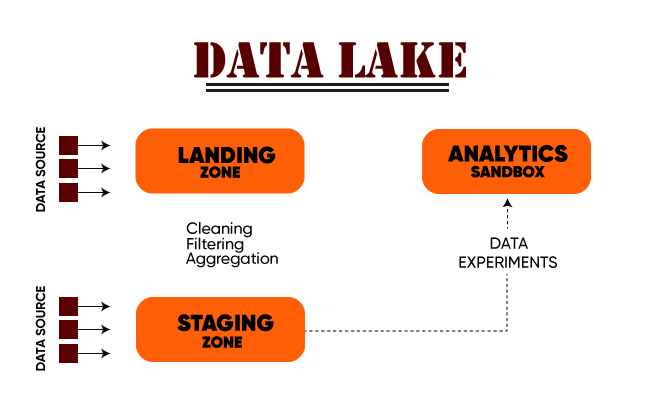
Enter the Data Lake—a centralized repository that allows organizations to store structured, semi-structured, and unstructured data at scale, retaining its original format until needed for analysis. Unlike traditional warehouses, data lakes provide flexible, scalable, and cost-effective storage, empowering organizations to unlock predictive insights, operational intelligence, and strategic decision-making.
From a consulting perspective, a data lake is more than a technology platform—it is a strategic enabler for digital transformation, advanced analytics, AI, and enterprise-wide innovation. This article explores the concept of data lakes in depth, providing a humanized, consulting-grade guide to strategy, architecture, governance, and best practices.
Understanding the Data Lake
A data lake is a centralized storage system that allows organizations to ingest data in its raw, native format, whether structured (databases), semi-structured (JSON, XML, logs), or unstructured (images, videos, emails).
Data Lake vs Data Warehouse
While often compared, data lakes and data warehouses serve different purposes:
| Feature | Data Lake | Data Warehouse |
|---|---|---|
| Data Type | Structured, semi-structured, unstructured | Structured only |
| Schema | Schema-on-read | Schema-on-write |
| Storage Cost | Low-cost, scalable storage | Higher cost, optimized for analytics |
| Flexibility | Highly flexible for analytics and AI | Optimized for structured reporting |
| Users | Data scientists, analysts, AI engineers | Business analysts, finance, reporting teams |
Consulting Insight:
Data lakes are ideal for advanced analytics, AI, and experimentation, while warehouses remain valuable for standardized reporting and business intelligence. Enterprises often implement hybrid architectures, leveraging both in a complementary fashion.
Why Data Lakes Matter
The strategic value of a data lake can be summarized in several key areas:
Breaking Down Data Silos
Enterprises often have fragmented data spread across ERP systems, CRM platforms, cloud services, and IoT devices. Data lakes enable centralized storage, creating a single source of truth for all organizational data.
Enabling Advanced Analytics
By storing raw data, data lakes empower:
-
Predictive analytics: Forecasting demand, detecting anomalies.
-
Prescriptive analytics: Recommending optimal actions based on patterns.
-
Machine learning and AI: Feeding models with diverse, high-volume datasets.
Cost Efficiency and Scalability
Modern data lakes, especially cloud-native solutions, offer elastic storage with cost-effective scaling. Organizations pay only for what they use while maintaining high performance.
Agility for Digital Transformation
Data lakes allow businesses to experiment and innovate. Analysts and data scientists can quickly test new hypotheses without waiting for traditional ETL processes to structure data.
Key Components of a Data Lake
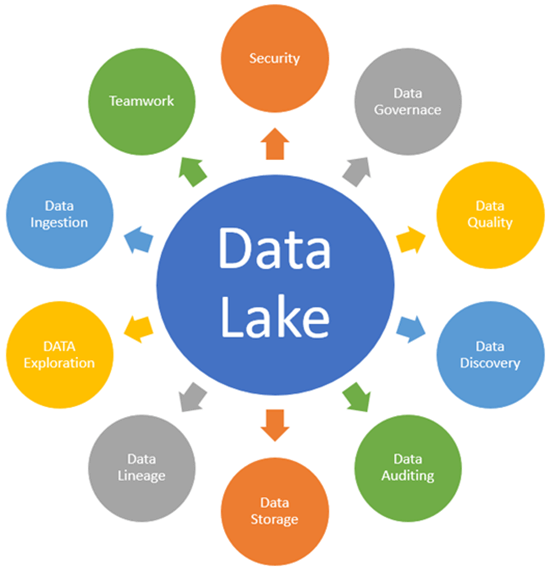
A robust data lake architecture integrates multiple layers and technologies.
Data Ingestion Layer
-
Batch ingestion: Periodic transfer of large datasets.
-
Streaming ingestion: Real-time data flow from sensors, apps, and logs.
-
Tools: Apache Kafka, AWS Kinesis, Azure Event Hubs.
Storage Layer
-
Raw data stored in object storage or distributed file systems.
-
Examples: Amazon S3, Azure Data Lake Storage, Hadoop HDFS.
Processing and Transformation Layer
-
Enables data cleansing, enrichment, and transformation.
-
Tools: Apache Spark, Databricks, Flink.
Catalog and Metadata Layer
-
Provides data discovery, lineage, and governance.
-
Tools: AWS Glue Data Catalog, Apache Atlas, Informatica.
Security and Access Control
-
Ensures compliance with GDPR, HIPAA, PCI DSS.
-
Techniques: Role-based access, encryption at rest/in transit, auditing.
Consumption Layer
-
Enables data utilization for analytics, reporting, machine learning, and BI dashboards.
-
Tools: Tableau, Power BI, Jupyter notebooks, SageMaker.
Governance and Compliance in Data Lakes
While data lakes offer flexibility, they pose governance challenges due to unstructured and semi-structured data. Effective governance ensures data quality, compliance, and security.
Data Quality Management
-
Validation: Ensuring incoming data meets quality standards.
-
Deduplication: Removing redundant records.
-
Normalization: Standardizing formats and units.
Data Lineage and Metadata
-
Tracking data origin, transformations, and usage is critical for auditing and trust.
-
Metadata enables analysts to discover data quickly and confidently.
Security and Privacy
-
Access controls prevent unauthorized data usage.
-
Encryption and anonymization protect sensitive information.
-
Compliance with regulations like GDPR, CCPA, and HIPAA is essential.
Policy Frameworks
-
Organizations should define data classification policies for structured, semi-structured, and unstructured data.
-
Automated tools can enforce policies at scale.
Common Data Lake Architectures
Consulting experience identifies several architectural patterns, each suitable for specific enterprise needs:
Traditional On-Premise Data Lake
-
Built on Hadoop HDFS clusters.
-
Pros: Full control over infrastructure.
-
Cons: High maintenance cost, limited scalability.
Cloud-Native Data Lake
-
Hosted on platforms like AWS, Azure, or Google Cloud.
-
Pros: Elastic scaling, managed services, reduced infrastructure overhead.
-
Cons: Data sovereignty and compliance considerations.
Lakehouse Architecture
-
Combines data lake storage with data warehouse capabilities.
-
Enables structured querying while retaining flexibility for unstructured data.
-
Tools: Databricks Lakehouse, Snowflake.
Data Lake vs Data Warehouse: When to Use Which
Consulting best practices recommend a complementary approach:
-
Data Lake: Best for raw, diverse datasets, advanced analytics, AI/ML, IoT streams.
-
Data Warehouse: Best for structured, curated data used in financial reporting, KPIs, dashboards.
Hybrid Strategy:
-
Ingest raw data into the lake.
-
Transform and curate selected data into warehouse tables for operational use.
-
This approach maximizes flexibility while maintaining governance and performance.
Key Challenges in Data Lake Implementation
Despite its advantages, data lake adoption is not without challenges:
Data Swamp Risk
Without governance, lakes can turn into “data swamps”, where data is inaccessible, inconsistent, or irrelevant.
Security Concerns
-
Storing sensitive data without proper controls increases exposure.
-
Cloud deployments require careful attention to access policies and encryption.
Skills Gap
-
Data lake implementation requires expertise in big data technologies, cloud architecture, and analytics.
-
Organizations often need training programs and consulting support.
Integration Complexity
-
Connecting multiple data sources, both structured and unstructured, can be technically complex.
Best Practices for a Consulting-Grade Data Lake
Define Clear Business Objectives
-
Establish KPIs and analytics goals before implementation.
-
Align data lake architecture with strategic business needs.
Implement Robust Governance
-
Metadata management, cataloging, lineage, and data quality rules are essential.
-
Assign data stewards for accountability.
Ensure Security by Design
-
Role-based access control, encryption, logging, and monitoring.
-
Consider compliance requirements from day one.
Leverage Cloud and Hybrid Models
-
Use cloud-native scalability while keeping sensitive data under regulatory control.
-
Implement hybrid solutions for legacy systems and critical applications.
Promote Data Literacy
-
Train business and technical users to access, interpret, and leverage data effectively.
-
Encourage a data-driven culture.
Continuous Improvement
-
Use feedback loops from analytics teams to optimize ingestion, storage, and processing pipelines.
-
Monitor performance metrics and cost efficiency regularly.
Consulting Recommendations
For executives and decision-makers considering a data lake, consulting-grade advice includes:
-
Conduct a Data Assessment – Understand current data assets, sources, and business priorities.
-
Develop a Roadmap – Prioritize data ingestion, governance, and analytics capabilities in phases.
-
Choose the Right Technology Stack – Cloud providers, processing frameworks, and BI tools should match organizational needs.
-
Implement Governance Early – Avoid data swamps by enforcing metadata, classification, and lineage rules.
-
Align with Analytics Strategy – Ensure the lake supports AI, ML, and advanced analytics initiatives.
-
Measure ROI – Track how data lake usage translates into business outcomes.
Future Trends in Data Lakes
AI and Machine Learning Integration
Data lakes serve as the foundation for AI/ML, providing diverse, high-volume datasets for training models.
Lakehouse Convergence
The line between lakes and warehouses is blurring, enabling real-time analytics on raw data while preserving flexibility.
Data Fabric and Mesh
Organizations are adopting data fabric or mesh architectures, enabling decentralized access and governance without losing central control.
Real-Time and Streaming Data
IoT, edge computing, and 5G technologies are driving real-time ingestion and analytics in data lakes.
Cloud-Native Evolution
Enterprises are moving towards fully managed, serverless lakes, reducing operational burden and enhancing scalability.
Conclusion
The data lake is more than just a repository—it is a strategic enabler of enterprise intelligence, innovation, and digital transformation. By centralizing diverse datasets, providing flexible storage, and enabling advanced analytics, data lakes empower organizations to make smarter, faster, and more informed decisions.
From a consulting perspective, successful data lake adoption requires careful attention to:
-
Governance and data quality.
-
Security and compliance.
-
Alignment with business objectives.
-
Integration with advanced analytics and AI.
-
Continuous improvement and cost optimization.
Organizations that treat data lakes as a strategic asset rather than a technical project will be well-positioned to thrive in an increasingly competitive, data-driven world.